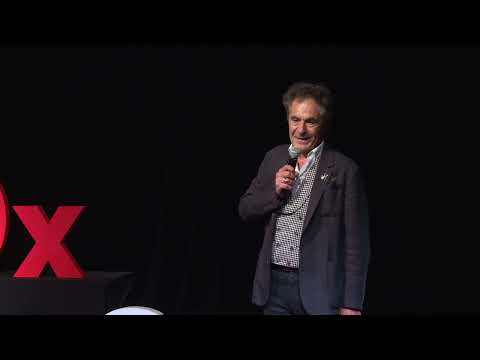
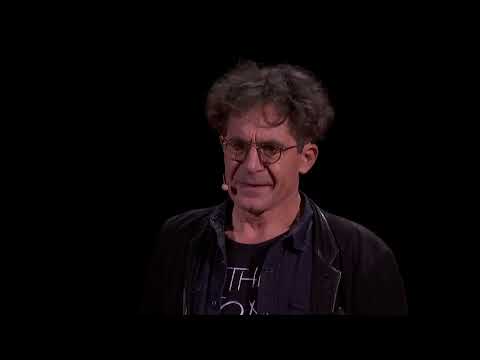
“Etienne Klein sheds light on the mysteries of modern physics to better question the meaning of the world.”
Etienne Klein
Etienne Klein
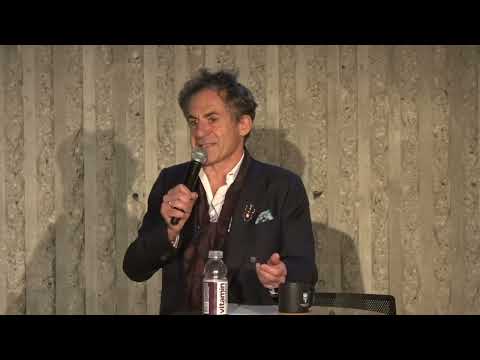
Étienne Klein is one of the leading French voices in contemporary scientific popularization. A physicist and philosopher of science, he occupies a unique position at the intersection of cutting-edge research and intellectual reflection on the meaning of scientific discoveries. His interventions, both demanding and accessible, invite the public to see the world differently, confronting common intuition with the sometimes bewildering laws of modern physics.
Trained at the École Centrale de Paris and holding a DEA in theoretical physics, he then pursued a doctorate in philosophy of science under the guidance of Dominique Lecourt, before obtaining a qualification to supervise research. This dual training allows him to engage with both equations and philosophical concepts with equal ease, making him a unique bridge between two often compartmentalized universes.
Joining the CEA in the early 1980s, he participated in major scientific projects, notably laser isotopic separation and the development of the LHC at CERN, where he was detached in the Accelerator Studies Group. Since 2006, he has led the Laboratory for Research on Matter Sciences (LARSIM), where physicists and philosophers work together on the foundations of science and their societal implications.
Alongside his research activities, Étienne Klein teaches quantum physics and philosophy of science at the École Centrale de Paris and participates in the LOPHISS Master's program at the University of Paris VII. A member of the Academy of Technologies and the scientific council of several institutions, he actively contributes to debates on the role of science in contemporary society.
Convinced that science should be accessible to the greatest number, he hosts the show La Conversation scientifique on France Culture weekly, which has become a reference in terms of dialogue between researchers and the general public. An author of more than thirty works and hundreds of articles in journals such as Pour la Science, La Recherche, or Philosophie Magazine, he has managed to build a rich intellectual oeuvre, intertwining the history of science, philosophical reflection, and pedagogy.
A Commander of the Academic Palms, Officer of the National Order of Merit, and Knight of the Legion of Honor, Étienne Klein has also received the Jean Rostand Prize as well as the Ernest Thorel Prize from the Academy of Moral and Political Sciences. Beyond these distinctions, his influence lies especially in his ability to reconcile scientific rigor and humanist culture, offering everyone keys to think about the contemporary world.
Chronos Tactics: Understanding Time!
- Time is one of the most evident yet most elusive realities of our existence. We live, think, and act in time, but we struggle to define it other than through metaphors or clocks. Étienne Klein starts from this everyday experience to show that time is not just a measurement, but a fundamental question that spans all disciplines.
- Through the history of science, he recalls how Galileo, Newton, and Einstein profoundly transformed our way of thinking about temporality. Relativity upheaved the notion of a universal and immutable time, showing that time depends on movement and gravity. This conceptual revolution forces everyone to rethink what they mean by "past," "present," and "future."
- The conference then explores the paradoxes of time, notably the arrow of time and the problem of irreversibility. Why do some things seem to go only in one direction, like aging or the diffusion of heat, while the fundamental laws of physics are reversible? Étienne Klein sheds light on this mystery by crossing physics and philosophy.
- Finally, he opens up dizzying perspectives on the origin of time and the universe. Did time begin with the Big Bang? Could it reverse one day? By blending scientific rigor and philosophical imagination, he offers the audience a deep and accessible reflection on one of humanity's greatest enigmas.
Journey into the world of quantum physics!
- Quantum physics has transformed our understanding of matter in the early 20th century. Étienne Klein traces the birth of this new science, which became essential when classical laws proved unable to explain the behavior of atoms and particles. He highlights the decisive role of figures like Einstein, Bohr, Heisenberg, and Schrödinger.
- Throughout the conference, he demonstrates how quantum mechanics challenges intuitive notions such as determinism, causality, or the objectivity of measurement. In the quantum world, the observer plays a central role, and reality seems to partly depend on the act of observation. This idea, as fascinating as it is unsettling, is explained with clarity and pedagogy.
- Étienne Klein also emphasizes the concrete applications of quantum physics, present in our modern technologies: semiconductors, lasers, medical imaging, or quantum computing. Far from being an abstract theory, it already structures a large part of our daily lives.
- Finally, he addresses the philosophical interpretations of quantum mechanics and their metaphysical implications. Is reality fundamentally probabilistic? Is there a reality independent of us? This conference invites everyone to reflect on the very nature of the real.
Of the virtue of paradoxes in physics!
- It is often believed that a paradox is a sign of scientific failure, but Étienne Klein argues the opposite. For him, paradoxes are essential engines of knowledge, as they force thought to break out of its routines and invent new theories. Without paradoxes, science risks stagnating.
- He presents several major paradoxes derived from relativity and quantum mechanics, such as the twin paradox or Schrödinger's cat. Each of these examples shows how an apparent contradiction can reveal an unsuspected depth of physical reality.
- The conference highlights the role of imagination and creativity in scientific work. Great physicists are not only calculators but also thinkers capable of questioning their own certainties. Paradoxes then become invitations to explore the unknown.
- In conclusion, Étienne Klein shows that paradoxes are not obstacles but trampolines towards new knowledge. They remind us that scientific truth is always under construction and that doubt is a fundamental intellectual virtue.
Are we threatened by science?
- Science has long been associated with the idea of progress, but this confidence has been shaken by events such as the invention of the atomic bomb. Étienne Klein reflects on this fundamental ambivalence: the same knowledge that enlightens can also destroy.
- He then analyzes the major contemporary controversies surrounding GMOs, climate change, nuclear energy, and cloning. Each time, the question arises: how far can we go in the name of progress? And who decides the acceptable limits? Science is not just a matter of facts, but also of values.
- The conference paints a nuanced picture of scientists, far from the clichés of the mad scientist or the irresponsible genius. Étienne Klein shows that most researchers are aware of ethical issues and seek to engage with society.
- Finally, he reminds us that the primary mission of science is not to define good or evil, but to unveil the illusions of common sense. It does not claim to reach an absolute truth, but a truth better than yesterday's, always improvable.
Physics and Philosophy: Rebuilding Reason!
- Étienne Klein starts with a simple question: are physics and philosophy incompatible? His answer is nuanced. While their methods differ, they share the same ambition: to understand reality and expand our horizon of thought.
- He shows how certain scientific discoveries have profoundly altered ancient philosophical concepts, particularly regarding time, causality, or the nature of matter. Physics does not merely describe the world; it transforms the way we think about it.
- As the conference progresses, he invites the audience to accept the intellectual turmoil provoked by modern science. Far from reassuring, contemporary physics disrupts our most deeply held certainties, but that is precisely where its richness lies.
- In conclusion, Étienne Klein calls for a true reconstruction of reason, based on dialogue between science and philosophy. It is not about choosing between them, but about making them work together to better understand our place in the universe.